
Essays
Exploring the
waning tradition
of sending out
holiday greetings.

The Philadelphia Inquirer:
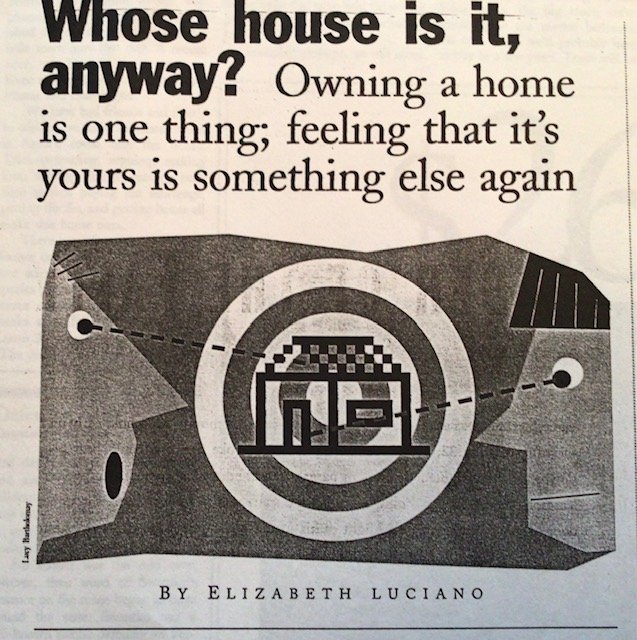
We’re the new people,
and we’ve just moved in.
Whose house is it now?
”Won’t this look nice?” they must have murmured. I regret to say it does not. And how were they to know that the master bedroom, with its pink-and-blue flowered paper, is practically a photograph of my mother’s?
Six months later, the house is a little more ours. We fixed the garage-door opener ourselves, throwing around words like “sprocket” and “cable.” We paid to have the microwave oven repaired. There is bright red, yellow and blue wallpaper featuring trains in the boy’s bedroom, and pale green paint in the girl’s. I sewed the curtains myself, with a minimum of talent and a lot of good luck. I muse over blank walls, outdated linoleum, and the avocado-colored toilet downstairs, figuring out what I can afford to transform next, and what must wait.
Of course, it is not just the look of the rooms that makes a house ours, it is the living in them. Three weeks after we moved in, my husband was stung by bees while mowing the lawn, and was rushed away by ambulance. A neighbor kindly phoned me at work and then finished the mowing. The house was a little more ours that day. A month later, we brought our new baby home and celebrated her arrival with champagne.
We have had friends and family to dinner; we have surmised which is Santa’s route into the house. Trick-or-treating, making love, cooking dinner, reading bedtime stories, paying the mortgage, getting the flu and getting better all make this house ours.
There are, of course, vestiges of former occupants: The first owners, tree scientists, left an experimental species of tree in the front yard. The leave turned yellow about three weeks after foliage season. Jason Loves X is scratched into a door. (The beloved’s name is scratched out, but even if it weren’t, I wouldn’t tell). A small question mark is inked on the kitchen wall, near the telephone. There are holes in the walls that once held the school pictures of other children. Including Joe.
Someday, perhaps, we will move on, and people will sneer at our flooring, mock our workmanship, cringe at our taste. But maybe they’ll like the cathedral ceiling in the living room, the big closet we installed in the master bedroom, the new fridge we’ll have to buy in a few years. There will be scraps of us: crayon marks, a scratch on the hardwood floor, the rusty latch on the shed.
It is our house now. But in a way, it will always be Joe’s house, too. I hope he stops by again someday, even if it’s just to use the bathroom.
From the Boston Globe
I was returning upstairs with a basket of laundry when I found a small, blond child in the living room, checking out the furniture. He wasn’t one of ours: our son and daughter are brunet and redheaded, respectively.
“Joe’s here,” said my father, who was visiting.
Dad was under the mistaken impression that Joe and I had previously made each other’s acquaintance.
“Hi, Joe,” I said, looking around for an accompanying adult. “Do you have a parent with you?”
Joe’s eyes roamed the room. Now he was evaluating the wall decorations: a bold sunflower print, a wooden “Bless This House” thing, a passe, cutesy wreath destined for the next tag sale. He looked back at me and shrugged.
“Nope,” he said.
Perhaps, I thought, he was from the neighborhood.
“Where do you live, Joe?”
He stopped assessing the decor and looked at me as though I were stupid.
“I used to live here,” he said simply.
Apparently, he’d rung the doorbell and strolled in to use the bathroom while his parents were visiting next door.
A solid three months after we’d moved in, Joe thought this beige split-level was still his house. And in a sense, it was.
Legally, houses change hands when we sign the endless papers and chide the lawyers for listing the man’s name first. Physically, they change hands when moving vans rumble up and down the driveway. But in reality, it takes months, even years, to truly own a house.
We shampoo the carpets and scrub the kitchen, knowing they are already reasonably clean. We have the septic tank pumped and the wood stove serviced. We want to know that the stray hair in the bathtub originated with us or someone we love. A lot.
We turn their TV room into our office. We slap four coats of primer over painstaking stenciling. We rid ourselves of the wheat-motif wallpaper in favor or faux-stone stripes. We get slap-happy on spackle, grout, and caulking compounds. Our kids get caught up in the fever, going willingly to the giant hardware store.
“Where are the bulbs?” I ask the salesguy.
“Flower or light?” he responds.
“Both.”
We feel a bit guilty. Someone now absent, the previous owners or the ones before them, worked hard applying the stencils and pasting the wallpaper, which is fading, or which we simply don’t like. Someone lovingly selected the Tiffany-style chandelier in the kitchen.
I am married to
the lion of the laundry room.
He’s particular,
but he’s not wrong.

From The Boston Globe
A long time ago, in my youth, I dashed a hoped-for romance by shrinking a sweater. It was green and belonged to a man I held in great regard. He was not pleased. My hopes for a romance were ruined, and I resolved to never again launder anyone else’s clothes. It was a vow I kept for nearly a decade, until my first child was born. Then I figured it was OK to bend the rules: I’d wash the baby’s clothes until he was old enough to complain about my lack of competence.
I am a fool in the laundry room. The collection of magical blue powders and elixirs intimidates me. I stuff everything into the machine, tangled and inside-out, and sneak a peek at the instructional chart on the detergent bottle, hoping for the best. Then the dial is spun like a roulette wheel. Round-and-round she goes, and where she stops, nobody knows. If the nylons get pummeled along with a load of blue jeans, so be it.
Partly because of my nonchalance, dime-size stains and marks appear on my clothes about 36 hours after I buy them. I have learned to place scarves and brooches strategically, and throwing on a blazer always helps, too.
The gods have a sense of humor: they send me a man who has an unparalleled aptitude for turning out towering stacks of crisp, clean, fresh-scented laundry. He is methodical, almost religious, in his rituals. He adds niceties like bleach and spray starch. HE adds detergent at a specific, scientifically determined nanosecond in the wash cycle. Even ancient tee shirts get the royal treatment, being draped majestically over the wooden drying rack. He has taken hand-me-down baby clothes and removed stains that have been embedded there through four or five infants. If he can’t banish a stain, nobody can. Should the Vatican ever set aside sanctity in favor of soapsuds and wish to have the Shroud of Turin neatened up, my husband’s the guy for the job. The man’s ability goes beyond simple talent. It would not be an exaggeration to say he has a gift. He sets no store in lemon fresh ‘n’ borax, whatever that is. He claims that high-quality laundering is the result of conscientiousness, rather than a particular product.
I suspect, though, that he’s got a genetic edge. His mother has the same talent, sharpened by raising seven children. She once put a silk blouse through the spin cycle with no ill effects. In my hands, the blouse would have promptly gone to that Great Hamper in the Sky.
Nonetheless, I still do my own laundry, and we divvy up the kids,’ depending on who notices that there are no clean pajamas in the dresser drawers. Sometimes, though, I turn to my husband for a consultation, having failed to remove the inevitable shadowy, oval mark. (His other gift is his homemade spaghetti sauce, which is excellent). I hand him the garment, along with a full report on my efforts. I don’t want him to think I’m not trying.
Usually, he shakes his head dispiritedly.
“You didn’t use stain remover, did you?”
I nod vigorously, having been unjustly accused.
“Did you let it set for ten minutes?” he asks.
The man does not mean nine minutes; nor does he mean eleven. He means ten. Well, no. It was probably more like seven minutes. I was in a hurry. I had to get to the pediatrician’s office and wasn’t included to spend my time baby-sitting a sweatshirt. So I confess.
“You’re not really making an effort,” he indicts me, quietly.
He’s right. The truth is, I don’t feel like bothering. There are errands to run, articles to write, snacks to prepare, people to contact. There are too many fascinating things to do, and laundry isn’t real high on the list.
Perhaps because I’m the official part-time homebody, I find excitement in small ways: using lots of hot sauce, planting unidentified flower bulbs, reading out-of-town news — and guessing at laundry. Loosen up! I want to yell. Go wild! Throw in a third dryer sheet, for goodness sake! Hey, a woman’s entitled to have some fun.
I suppose my failure to make a proper effort with Woolite is the “or for worse” element to which our wedding vows referred. Sometimes we come to loggerheads, he with my haphazardness, me his his occasional inflexibility (but it’s a very endearing inflexibility, sweetheart).
Maybe that’s OK. After all, we have different last names, go to different dry cleaners and have separate savings accounts. None of those decisions indicates a loss of love, or makes us any less married. We value the same things: education, financial responsibility, and clean clothes. We just have different ideas about how to achieve them.
My energy and his measured ways are a goo balance: everyone has something to offer. I hammered out the deal on the house, while he scheduled the inspections. He also went directly to the basement to check the viability of the heating system. Energy combined with realism. I think it’s a fine combination.
I may not be lucky in laundry, but at least I was lucky in love. It means something, that two people who are so different can live together peaceably, even happily. We have been told that we make a handsome couple. One thing is certain: our clothes are clean.
And his have been neatly pressed.
More essays…
“Say ‘I Don’t’ to Corporate Logo” - the Philadelphia Inquirer
“Forty’s Just Fine” - The Philadelphia Inquirer
“Proud to be from Belchertown” - the Boston Globe.
“Saluting the Guy Patrol” - the Boston Globe.
“Giant Steps” - Hampshire Life
“Seamstress hangs on by a Thread” - the Boston Globe
“Gearing up to an automotive love” - the Boston Globe
“Just a few little (kitchen) Gadgets” - the Boston Globe
“Knucklehead Days” - UMass Magazine
“I Like Massachusetts” - the Boston Globe
“Who Needs Sunshine for a Tan?” - the Boston Globe
“The Total College Experience” - the Boston Globe
“Skater Whose Memories are Better than Reality” - the Boston Globe